
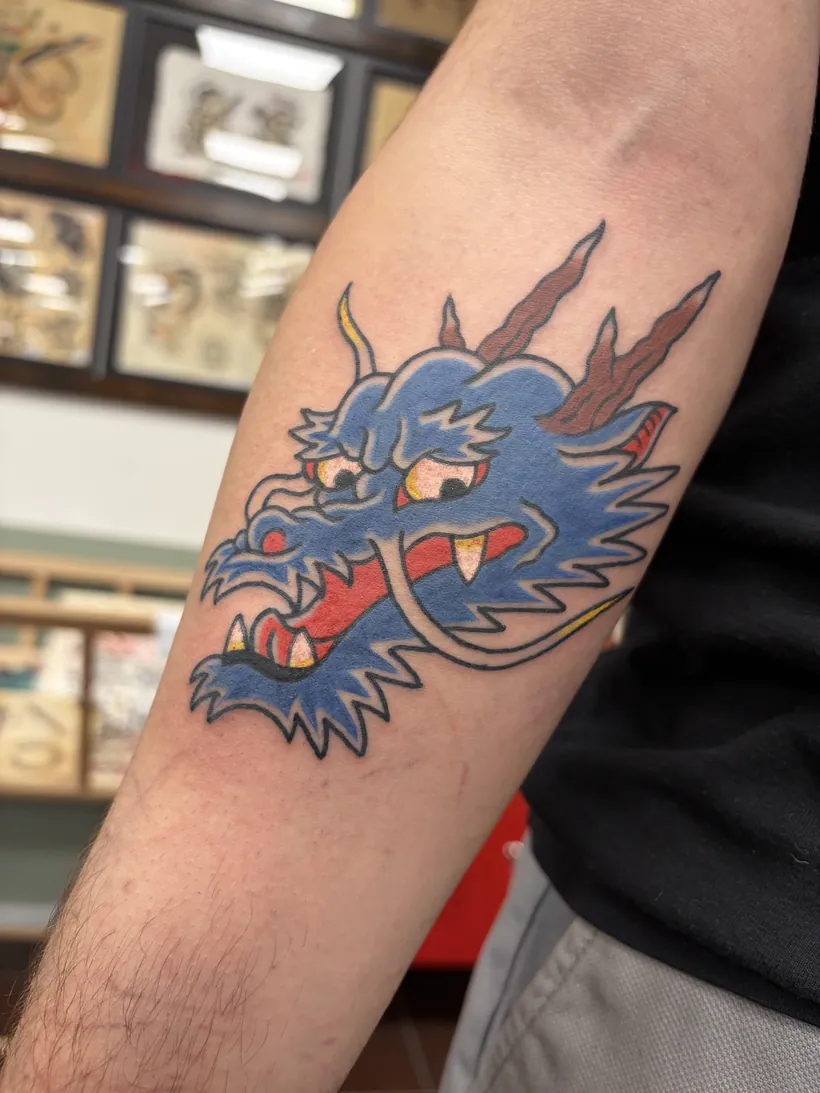
Japanese Traditional: mythology in the skin
Dragons, koi carp, hannya masks and waves. Where Japanese tattooing comes from, what the individual motifs mean, and why irezumi works only when you think about the whole.
Where irezumi comes from
Japanese tattooing in the form we know it took shape in the Edo period, roughly across the
eighteenth and nineteenth centuries. It owes a great deal to ukiyo-e woodblock prints, and
above all to the illustrations for the Chinese novel Water Margin, whose heroes had
bodies covered in dragons, tigers and flowers. People wanted to look like them — and tattooists,
who until then had mostly done lettering, began drawing whole compositions.
That is also where the thing that makes the Japanese style Japanese comes from:
a motif never stands alone. It is always set into a background that gives it
direction and movement.
Composition: what holds it together
Irezumi works in two layers. There is the main subject — a dragon, a koi, a hannya — and the
background around it. The background is not filler. It has its own rules and its own names:
- Nami — waves. The most common background. They give the subject movement and act as the water it emerges from.
- Kumo — clouds. Used where the subject should read as lofty or otherworldly.
- Kaze — wind, drawn as a run of long lines. It joins separated parts of a composition.
- Iwa — rock. It gives the composition weight and ground.
These elements do what perspective does in painting: they tell the eye where to look and which
way to travel. That is why Japanese work is drawn for the whole area at once, not piece by piece.
The main motifs and what they carry
Dragon (龍, ryū)
In Europe the dragon is a monster to be killed. In Japan it is a guardian of water and wisdom,
a creature more benign than dangerous. The Japanese dragon has three claws (the Chinese one has
four or five), a serpentine body without wings, and whiskers. It is at its best on a sleeve or a
back, where it has room to coil.
Koi carp (鯉)
The legend has a carp swimming up the Yellow River against the current as far as the Dragon Gate
waterfall, where it turns into a dragon. So the koi stands for
perseverance and getting past an obstacle. The direction it swims matters: upward
means the obstacle is still ahead of you, downward that it is behind you.
Hannya (般若)
A mask from Noh theatre. It shows a woman whom jealousy and grief have turned into a demon. It is
not a symbol of evil but of suffering and transformation. What makes it remarkable
is that the mask reads as angry from one angle and sorrowful from another. That is deliberate.
Shishi (獅子)
The guardian lion whose statues stand in front of shrines. A symbol of protection. It is often
drawn paired with a peony — the lion is force, the flower is delicacy, and together they balance.
Tiger (虎)
The dragon’s counterpart. The dragon rules water and sky, the tiger earth and wind. It protects
against sickness and bad spirits. The two often appear in one composition as forces held in balance.
Flowers
- Peony (botan) — the “king of flowers”, wealth and daring.
- Cherry blossom (sakura) — impermanence. It falls at the height of its beauty, exactly as bushidō held a samurai should.
- Chrysanthemum (kiku) — longevity, and the imperial emblem.
- Maple (momiji) — autumn and the passing of time.
Colour or black and grey
Classic irezumi is in colour — strong red, green and blue against black background work. The black
and grey version is more recent but equally respected today. It has two practical advantages: it
ages a little better, and it is more reliable on darker skin.
If you are undecided, look at what you already have tattooed and at how it has aged. That tells
you more than what happens to be fashionable.
Where Japanese work belongs
The style was designed for large areas and that is where it is strongest: sleeve, back, thigh,
chest. That does not mean a smaller motif is pointless — a hannya on the forearm or a daruma on
the calf work very well. They are simply drawn differently from a detail lifted out of a large
composition.
If you are planning to build up to something larger over time, tell me at the outset. The first
motif can then be placed so the rest can be added around it later — and you will save yourself a
great deal of trouble.
How to start
You need neither a finished design nor any knowledge of Japanese mythology. Just tell me which
motif speaks to you and where you want it. The rest — the composition, the background, the size —
we work out together. More on the page about
Japanese tattooing, or go straight to the
booking form.