
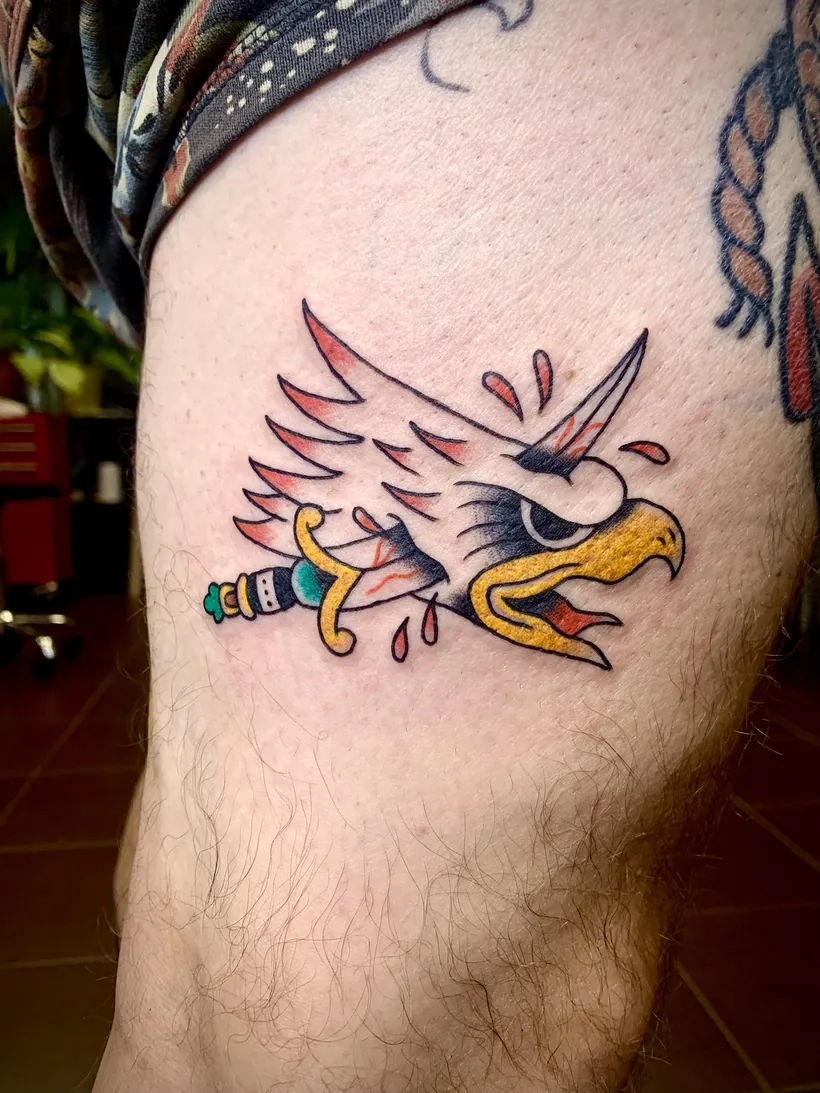
American Traditional: a timeless classic
From sailors to the present day. Why heavy lines and saturated colour survive decades while delicate tattoos fade — and what the classic motifs originally meant.
Where it came from
American traditional was born in the ports at the beginning of the twentieth century. The people
getting tattooed were sailors, soldiers and labourers — people with no time for long sittings who
wanted a motif that read at a glance. The name most associated with the style is Sailor Jerry,
that is Norman Collins, working out of Honolulu.
The conditions the style grew up in are the reason it looks the way it does. A tattoo had to
survive sun, salt water and years of physical work. Anything delicate would have been lost.
Bold will hold
That is the whole philosophy of the style in three words.
A heavy line and solid colour survive; fine detail spreads.
The reason is physical. Skin is not paper — it is living tissue that renews itself. Ink sitting in
the second layer of skin migrates sideways a little over the years. In a heavy line you never see
it; the line simply softens slightly. In a hairline, two neighbouring strokes merge into one grey
one inside a decade.
So you will not find photorealistic shading or soft gradients in traditional work. You will find a
clear shape, a silhouette you can name, and colour that holds.
The classic motifs and what they meant
Traditional motifs are not random pictures. Most came out of the maritime world and carried a
specific meaning — something close to service badges.
- Swallow — five thousand nautical miles sailed. Two swallows meant ten thousand. It also stands for the journey home, because a swallow always returns.
- Anchor — an Atlantic crossing; later, stability and a fixed point in general.
- Eagle — patriotism and freedom. The oldest American motif.
- Panther — courage, strength, aggression. A classic for the forearm and the chest.
- Rose — love, and also impermanence. The most versatile motif there is.
- Dagger — bravery; through a heart or a skull, betrayal or revenge.
- Pin-up — the girl waiting at home. These days more a nod to the style than a statement.
- Heart and banner — room for a name. The ancestor of every “tattoo that means something”.
The palette
The traditional palette is deliberately narrow: black, red, yellow, green, and later blue. That is
not a shortage of options — it is a compositional tool. A small number of
saturated colours holds the piece together and keeps it legible from three metres away.
If you want something quieter, black and grey traditional is a full alternative. It reads calmer
and works more reliably on darker skin.
Why size matters
Traditional has a minimum size, and it is somewhere around 8 to 10 cm. Below that
you cannot hold a heavy outline and a solid colour field. You will get a motif, but it loses
precisely what made it traditional — and in a few years it closes up.
The usual size is 10 to 20 cm. Larger areas in this style are not assembled into one continuous
composition the way they are in Japanese work, but out of several separate motifs with space
between them.
How it ages
Better than any other style. Traditional work done well looks much the same after fifteen years as
it did after five — the colours simply soften. That is why it is called a timeless classic, not
because it is old-fashioned.
To see actual pieces, have a look at the
american traditional page or the
gallery.